Volunteers are a crucial part of the National Railway Museum. From sharing knowledge with the public to working behind the scenes, there are lots of opportunities to make a difference, develop skills and use expertise.
Esme’s Story
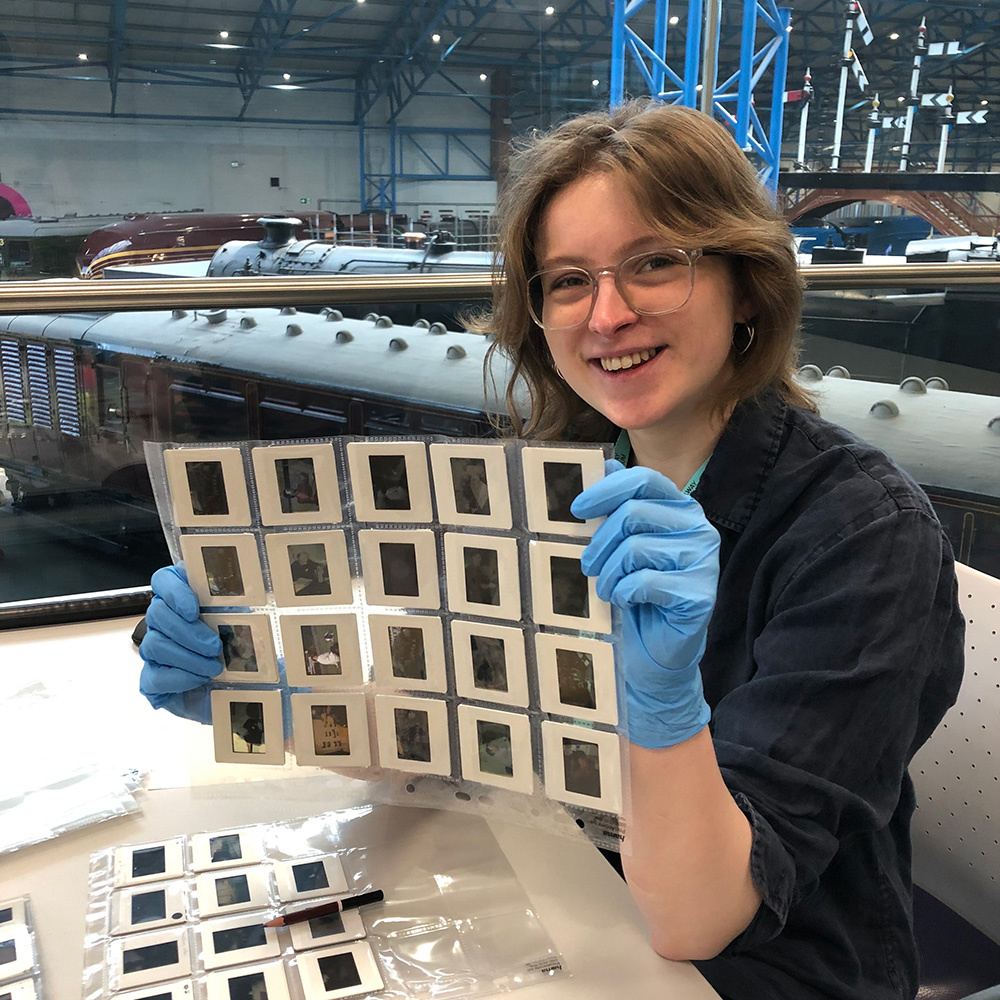
I’m Esme, and I volunteered with the archives team, assisting with the cataloguing of the archive of the Campaign for Better Transport, an advocacy group that has been active since 1973.
About the archive and why it needed volunteer support
The Campaign for Better Transport archive mainly consisted of documents: meeting minutes, copies of pamphlets and books, heavily annotated emails and white papers, or photos from demonstrations, campaigns and conferences. When the archive arrived at the museum, it had been hastily packed into brown paper bags when the office was being cleared out. Documents were out of order or folded haphazardly, or labels on the bags did not match the contents.
A concerted effort was needed to get the archive up to disciplinary standards ahead of being made available to researchers and the public.
My responsibilities
My tasks involved updating the metadata for certain objects, mainly placards and photos, ahead of uploading to the collections management software. I also assisted with document first-aid which included re-packaging, getting rid of rusty paperclips and bulldog clips, and generally organising and sorting documents.
My highlights
It was really exciting to be able to take part in this process—I look forward to seeing how the material is used in the new galleries and by researchers.
Some highlights of the material include photographs of ‘Sardine Man’, a man in a sardine costume who would get on packed commuter trains to highlight overcrowding in the noughties.
It was interesting seeing the general progression of technology over the decades the Campaign has been active, from faxes and letters to printed emails, or from slides to digital photographs.
It was also incredibly interesting to see documents about railway privatisation and the Channel Tunnel—two bulwarks of British transport that seem (until recently), unchanging. Seeing the level of back-and-forth over wording in policy papers and vitriolic emails, so much red pen, was fascinating.
I really enjoyed my time at the National Railway Museum; thank you for providing this opportunity and to everyone for being so welcoming!
Well done, Esme. This is really valuable work that you are delivering.
At the Railway & Canal Historical Society we have around 200,000 photographs in a range of formats that we are steadily putting online so they can be made freely available to researchers and the general public. Thus far we have put 25,000 of them online: https://www.rchsimagearchive.org.uk/
One of our difficulties with volunteers is that, unlike the NRM, we do not have permanent premises.
Everyone should have an Esme!
Hello National Railway Museum in York
I saw that the locomotives, coaches, wagons and other vehicles have small signs on them that say do not climb
Please can you people at the national railway museum in York tell me why the locomotives, coaches, wagons and other vehicles have small signs that say do not climb on them if you could
From Saul Canton Newton age 25